Love Hina and my romanticization of university
They are not
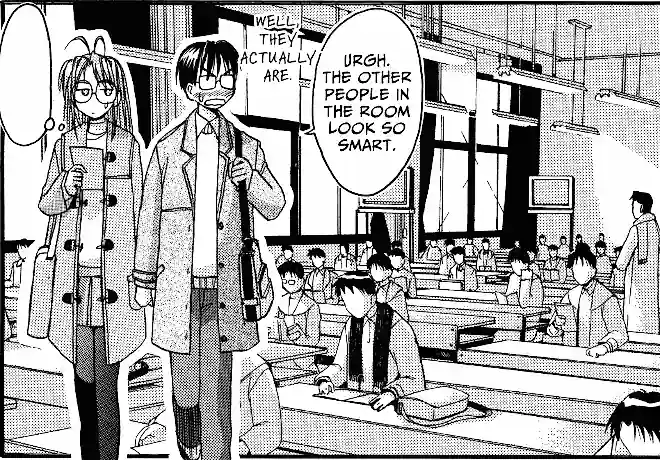
During my teenage years, the only manga I picked up was Love Hina. While the pretty women and tropes are meant to appeal to young guys like my former self, they were not what hooked me in. The cute designs probably helped a bit, but I don’t think I’ve ever tolerated reading or watching anything for the designs alone, and for the most part, Love Hina isn’t something that I would describe as… good. The actual reason I kept reading was the main protagonist’s goal of getting into Toudai, the University of Tokyo, after he had already failed to do so in two previous attempts.
At the beginning of the manga, Keitaro and Naru’s lives revolve around their efforts to be admitted to Toudai. I think this university was portrayed as having great prestige in the manga, to the point that the chance of becoming a student at Toudai felt as serious as Ash/Satoshi’s goal of becoming a Pokemon Master. Both Keitaro and Naru go through a lot of frustrating shit (more frustrating for the reader, to be honest) for another couple of years until they got what they wanted. Each of them has their own motivations, and the relationship they develop is important to the plot, but none of that matters in this blog entry.
I was conditioned to believe that being a university student was an amazing part of everybody’s lives in general, and that it was the only option you could start your adult life with. This mythologization is embedded in this silly manga, but said manga couldn’t fool me: the world did. Supposedly, I knew that nothing in this manga was meant to be taken seriously, but at the time I didn’t consider that becoming a university student was something you choose because you want to, among many other options. I thought that going through university would give me many good relationships, critical thinking, and overall a happy career. It turns out none of these things is guaranteed in real life, and that there should be no shame in not having a degree. In contrast, I had to switch careers before actually making long-lasting friends, I had to live a few more years to learn that critical thinking is not really taught at uni, and I found out that the future of your career can’t be foreseen. Love Hina presents a mindset toward university that already functions as common sense outside of its fictional world, so I never questioned it.
I should add that I believe there’s great value in university. Ongoing conservative trends dismissing or fighting against its role in society are not something I support. This doesn’t contradict the fact that I came across many students who felt proud about being at uni for some kind of mystical wisdom, as if repeating the theory they read in their textbooks magically made them smart. “We’re not here to do silly and trivial things, we’re in university,” said the worst teaching assistant I’ve ever seen, lowkey trashing technical jobs. Looking back, this doesn’t feel too different from what’s portrayed in Love Hina. The prestige of getting accepted to Toudai is a perception that every character has internalized. They mention multiple times that only the smartest people study there, but they never mention why, or what makes them smart. In our reality it has more to do with opportunity and then effort than innate intelligence. In any case, what makes them “smart” is, in many occasions, just knowledge. Highly educated people would agree that many universities advocate for their students to develop critical thinking, but critical thinking should be applied to everything, including the textbooks they are meant to read. Critical thinking isn’t even explicitly mentioned in the actual content of the educational programs I’ve seen; it’s just something thay they pretend students to develop by osmosis, admitting but immediately forgetting that all of us have biases. I used to treat the learned theory as facts rather than as conclusions reached by someone else. It took me years before I started the habit of writing “the author says/argues/proposes/suggests/states” instead of “this is like this.” I’m not saying the theories were wrong, but I’m not the one who did the actual research.
I could give Love Hina some credit, because Keitaro, Naru, and the archaeology professor Seta are not particularly sharp in terms of critical thinking. But when I read it, it felt more like the story demanded absurd characterizations for comedic purposes, making them contrast with the idealized image of students and graduates.
I also believed university trained skilled people, but in reality it trains professionals at best, and not always good ones. Keitaro and Naru’s passions push them to become a good archaeologist and a good teacher respectively, but it’s never told how studying helped with that. Realizing that people with perfect grades can be terrible in the practical applications of their fields was shocking to me. But even worse was realizing there are people who find their chosen careers useless and of little value from the get-go. The passion I had for my field was as strong as Keitaro’s, and I thought other people had similar feelings. What were they even studying for? Did they not care about developing real expertise?
I think my degree is useless. But if I was given the chance, I would still pursue a university education. There are many flaws in this institution that doesn’t know how to reconcile its centuries-old structure and logic with the fast and hostile world, but it’s the best we have to push society forward. I just think the arrogant mythology around it should die for good. Someone should write a manga about it.